


THE ESSENTIALS
- Forest fires don’t just damage trees. The flames also affect the soil, the life it supports, and the carbon stored within it.
- The extent of these impacts varies depending on the temperatures reached and the soil’s ability to recover.
- Fire also tends to reduce soil carbon stocks.
It’s impossible to have missed it: this summer of 2026, an unprecedented area of French forest burned. But behind the spectacular images of scorched landscapes, another, less-documented story is unfolding right beneath our feet. Beyond the burned vegetation, fire profoundly transforms the soil and the life it harbors.

It also affects an invisible asset: soil carbon reserves, which the general public often tends to underestimate. Yet French forest soils often store more carbon than the above-ground portion of the forest.

To understand these changes, let's start by looking at what happens in the soil after a fire.
How does fire affect the soil?
Contrary to the image we might have of a fire consuming everything in its path, heat generally penetrates the soil only to a limited extent. Because of the soil’s low thermal conductivity, its direct effects are most often limited to the first few centimeters below the surface. Yet it is precisely in this thin layer that the majority of the roots, microorganisms, and organic matter—which ensure soil fertility, carbon storage, and soil function—are concentrated.
Once the flames have been extinguished, the soil retains the memory of the fire, with consequences that can last for years, or even decades, for ecosystem regeneration and the climate.
Changes in Chemical Composition
This impact is primarily related to the chemical composition of the soil, which will change as a result of the heat.
The burning of vegetation and the accumulation of dead leaves and plant debris on the forest floor (forest litter) leaves ash on the soil surface that is rich in minerals, particularly calcium, magnesium, and potassium. These nutrients—which are crucial for plant cell structure, photosynthesis, and water regulation—will therefore be more readily available. Conversely, certain nutrients essential for plant growth—particularly nitrogen and sulfur—can be lost through volatilization at temperatures as low as 200 °C.
Ash, which is generally alkaline, can also temporarily raise the soil's pH.
By degrading the organic matter that helps hold soil particles together, a fire can also weaken the soil’s structure and alter its porosity. This makes it harder for water to infiltrate, which increases the risk of runoff and erosion.
Variations Based on Temperature
These effects can sometimes be amplified by certain phenomena. When exposed to heat, organic compounds released from burning vegetation can vaporize, migrate into the soil, and then condense onto cooler particles. They then form a hydrophobic layer that repels water. This can have negative consequences for the soil’s water-holding capacity and, consequently, for plant growth.
This water repellency is most pronounced within certain temperature ranges, between approximately 200 °C and 280 °C, whereas at higher temperatures, the organic compounds responsible for this effect can themselves be destroyed.
Differences Between Sandy Soil and Clay Soil
In addition to temperature, other factors can also significantly alter the effects of a fire on the soil: intensity, duration, amount, and type of fuel, as well as the properties of the soil.
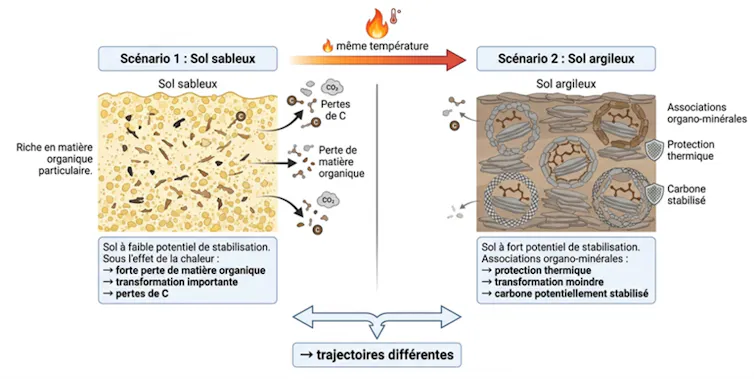
In sandy soil, such as in the Fontainebleau Forest (Seine-et-Marne), for example, there will be a greater reduction in soil organic matter compared to clay soil, such as certain soils in the Aude department. This is because, in sandy soils, soil organic matter is primarily present in the form of plant debris that is poorly protected, unlike in clay soils, where soil organic matter is more likely to be bound to clay particles. This binding between soil organic matter and clay particles is so strong that it acts as a protective layer.
These clay soils, therefore, are capable of stabilizing a significant portion of the organic matter in contact with the minerals. As a result, they provide better carbon sequestration than sandy soils.
An Underground Life Turned Upside Down
The effects of fire on forest soils do not end there, because fire not only alters the chemistry and structure of the soil—it also disrupts the organisms that live there. Soil is home to an extremely diverse community of bacteria, fungi, and animals that play a key role in the decomposition of organic matter and in the carbon and nutrient cycles. Heat can very quickly cause the direct death of some of these organisms.
By altering the pH, nutrient availability, organic matter, and the physical properties of the soil, fire also transforms, over time, the living conditions and resources available to organisms. This disruption results in a decrease in the activity of fungi and microorganisms, which, through their enzymes, break down organic matter and make nutrients available that are essential to the fertility of the entire forest.
As a result, the soil’s biological functioning may remain disrupted long after the ash has disappeared, with recovery times that can span several years or even several decades, depending on the severity of the fire and the characteristics of the ecosystem.
Does all the carbon go up in smoke?
Now let's take a look at what's happening with soil carbon stocks.
One might think that a fire converts most of the carbon in the soil into CO2, which is then released into the atmosphere. The reality is more complex. Some of the carbon-containing substances in the soil’s organic matter are, in fact, consumed by the flames. But another portion of the soil’s carbon is not destroyed: it is transformed.
To understand this transformation, it is necessary to distinguish between the various forms of carbon present in soil organic matter. The forms known as “O-alkyls” correspond mainly to carbohydrates, such as those found in the cellulose and hemicellulose of plants. They constitute an easily accessible energy source for microorganisms.
Alkyl compounds include molecules with longer carbon chains, such as waxes and certain plant lipids. Finally, aromatic carbon consists of molecules organized into carbon rings, which are generally more resistant to biological decomposition.
Under the influence of heat, the O-alkyl and alkyl forms gradually decrease, while the proportion of aromatic carbon increases. As the temperature rises, certain chemical functions disappear in turn, and the molecules condense, leaving a residue increasingly rich in aromatic structures: pyrogenic carbon. Charcoal is the most visible form of this, but similar compounds also form in the soil after a fire.

Fire thus produces a new form of organic matter that is structurally more compact and chemically different from the organic matter that existed before the fire. This carbon can then interact with soil minerals and persist longer than the organic matter from which it originated. One might therefore think that fires promote the storage of a more stable form of carbon in the soil. The reality, however, is more nuanced.
Different scenarios depending on the intensity
Depending on the severity of the situation, a fire can result in a significant loss of organic matter, a simple transformation of the most readily degradable compounds, or even a temporary increase in soil carbon due to the accumulation of carbon-rich residues from combustion. This phenomenon is observed in particular in certain traditional slash-and-burn systems.
This surprising result is due to the fact that fire consumes some of the organic matter, but it also produces carbon-rich residues, such as pyrogenic carbon, which can, in certain systems, offset the losses.
However, a recent scientific review encompassing 471 studies and more than 5,000 observations from around the world shows that, overall, fire tends to reduce soil carbon stocks, with particularly pronounced effects when fires are severe or recurrent.
After the fire, the soil continues to change
When the flames die down, the soil is not permanently altered. Although soils retain the memory of fires, vegetation begins to grow again, microorganisms gradually recolonize the environment, and the ashes can temporarily provide nutrients to plants. A recovery phase then begins, the speed and extent of which depend on the severity of the fire, soil properties, and ecosystem characteristics.
In certain ecosystems, such as savannas, Mediterranean landscapes, or dry forests, fire is part of the natural cycle and can contribute to nutrient recycling or the maintenance of certain species. These environments have evolved with regular fires—generally of low intensity—which help release nutrients from dead vegetation and create open spaces conducive to germination or the regrowth of new species. Some Mediterranean species, such as the Aleppo pine and several rockroses, even benefit from the passage of fire to regenerate. The intense heat of the flames melts the resin that kept their cones closed, releasing thousands of seeds onto soil enriched by the ashes.
The problem arises when the fire regime changes. A moderate fire followed by rapid recolonization does not have the same long-term consequences as severe or repeated fires, which can occur before the soil and vegetation have had time to recover. Disturbances can then accumulate, leading to carbon losses and, more broadly, a lasting alteration in soil function.
After a fire, should we take action?
Since soils and ecosystems have a natural capacity to recover, should we intervene after a fire to speed up their recovery? In many cases, allowing the environment to recover naturally may be the best option.
Intervention is particularly warranted when fire has made the soil especially vulnerable to erosion, mudslides, or the transport of sediment into waterways and infrastructure. In these areas, covering the soil with straw, wood chips, or other materials can protect its surface from the impact of raindrops and limit runoff and erosion.
Conversely, certain actions taken shortly after a fire can exacerbate the damage. The passage of heavy machinery—particularly when clearing burned trees—can compact soil that is already weakened, degrade its structure, and increase erosion.
In the era of climate change, with wildfires becoming more frequent and intense, one crucial question remains: To what extent can soils absorb these disturbances without their functioning being permanently altered? To answer this question, studying the mechanisms that promote or limit this resilience is more crucial than ever.
This article was supported by Quentin Bordier, a science writer. We thank him for his help in making this discussion accessible to a general audience.
Murilo Veloso, Lecturer and Researcher in Soil Science, AGHYLE Unit, Rouen Campus, UniLaSalle, and David Houben, Lecturer and Researcher in Soil Science and Director of the Agrosciences College, UniLaSalle
This article is republished from The Conversation under a Creative Commons license. Read the original article.


