What if nature held the key to protecting our crops?
It is this conviction that brings together Biom InnoV and UniLaSalle’s AGHYLE research unit in a joint scientific chair, officially launched in early 2026.
Why Biocontrol?
For more than half a century, crop protection has relied heavily on synthetic products that are effective but have recognized side effects: impacts on biodiversity, ecosystems, and human health.
Over the past two decades, alternative solutions have emerged: biocontrol solutions that harness the natural mechanisms of living organisms—beneficial insects, microorganisms (bacteria, fungi, viruses), substances of plant, animal, or mineral origin, and chemical mediators such as pheromones.
Crop protection relies on synthetic products
While these biocontrol solutions are largely compatible with organic farming, they can also be integrated into conventional systems, where the need to reduce environmental impact is growing.
The “Biocontrol Explorer for Plant Health” Chair is the culmination of a multi-year collaboration focused on a common goal: reinventing crop protection for sustainable and resilient agriculture.
This chair serves as a strategic lever to accelerate the discovery of new biocontrol molecules, anticipate plant health challenges, address evolving pathogens and increasing regulatory requirements, and train the talent of tomorrow. The projects conducted here will have a direct impact in the field, providing farmers with effective, accessible, and sustainable tools. “Let’s protect crops and preserve the future.”
Aude Bernardon-Méry, founder and president of Biom InnoV
Two players, one shared goal
Biom InnoV (Saint-Malo) is a mission-driven startup founded by Aude Bernardon-Méry and AgriLife Studio. It develops bioactives to combat crop diseases, using a holistic, ecosystem-centered approach (considering the plant along with its entire microbiome).
Its ambition: to become a global leader in the identification of bio-based active ingredients. A member of France Biocontrôle by IBMA since early 2026 and supported by the BPI, Saint-Malo Agglomération, Le Pool, and competitiveness clusters such as Vegepolys Valley and Valorial.
UniLaSalle is a higher education and research institution with five research units that bring together more than 200 scientists. The Agroecology Research Unit (Agroecology, Hydrogeochemistry, Environments & Resources – AGHYLE), with its 50 scientists and cutting-edge technological platforms, is recognized for its expertise in soil science, microbial ecology, soil-plant-microorganism interactions, and plant nutrition and health.
Agriculture lies at the heart of the challenges of food, energy, and environmental sovereignty. By partnering with Biom Innov, we are creating synergy between science and innovation at the heart of soil-plant-microorganism interactions, with the goal of generating robust knowledge to support the development of innovative solutions.
Through this partnership, we are reaffirming our ambition as a higher education and research institution: to educate, innovate, and take concrete action to address the challenges of agroecology, thereby contributing to sustainable, life-based agriculture.
Isabelle TRINSOUTROT-GATTIN, Director of the AGHYLE Research Unit at UniLaSalle
The Chair: A Shared Home
A chair is a structured partnership that brings together companies, academic institutions, and sometimes local governments around a common research theme.
The “Biocontrol Explorer for Plant Health” chair formalizes the collaboration already underway between Biom InnoV and AGHYLE, with the goal of developing high-throughput screening methods to evaluate new bioactive compounds against crop pathogens.
What the Chair Will Contribute
Biom InnoV’s goal is to provide farmers in France and beyond with effective, easy-to-use, and affordable biocontrol solutions. “Biocontrol Explorer for Plant Health” is the platform that brings this ambition to life, thanks to an innovative approach based in particular on the exploration of an unprecedented diversity of bioactive compounds across multiple plant-pathogen systems and the deployment of screening technologies that take microbiomes into account.
Une vision partagée de l'avenir
Pour UniLaSalle, s’associer à une jeune société innovante française portant une vision pertinente des besoins agricoles s’inscrit pleinement dans son ADN.
Pour Biom InnoV, cette chaire est le levier indispensable pour passer de la promesse scientifique à l’impact terrain, et participer encore plus efficacement au basculement durable vers les solutions de Biocontrôle.
The need for crop protection solutions that are effective while respecting the environment and human health is becoming more urgent every day.
At the same time, significant scientific advances are emerging in our understanding of microbiomes and the interactions between plants and the microorganisms they host, enabling us to better protect and nourish them. The Biocontrol Explorer Chair comes at just the right time to transform these advances into innovations that benefit farmers.
Christian HUYGHE, former Scientific Director for Agriculture at INRAE, project manager at INRAE
How does it work in practice?
This research is being conducted by Biom InnoV and researchers at UniLaSalle, who have access to advanced laboratory equipment and a greenhouse for phenotyping. The research focuses on the plant, its microbiome, and pathogenic microorganisms, which will be studied using a combination of approaches from molecular biology, cell biology, analytical chemistry, biochemistry, and imaging.
The goal is to develop high-throughput screening methods to select plant extracts and bioactive compounds. Insights into the mode of action of botanical extracts will be shared for initial field evaluations, thereby feeding into Biom InnoV’s development pipeline.
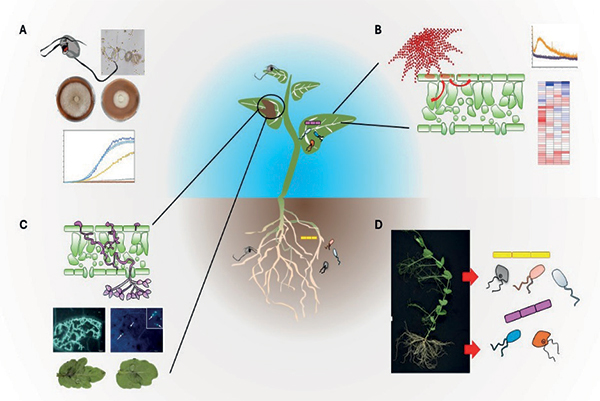
La plateforme repose sur 3 unités :
- Unité d’évaluation sur des pathogènes (figure A)
- Unité d’évaluation sur la protection de la plante (figure B et C)
- Unité d’évaluation sur le microbiote, (figure D)
Le microbiote de la plante : une frontière scientifique
L’unité AGHYLE a développé une expertise dans le suivi des micro-organismes en interaction avec la plante, aussi bien au niveau racinaire (rhizosphère) qu’aérien (phyllosphère). Certains scientifiques comparent cet environnement microbien à une première ligne de défense, analogue au microbiote humain. La chaire explore et valorise ce levier pour renforcer la résistance naturelle des cultures face aux pathogènes.
This partnership marks the beginning of an exciting journey. We are convinced that the success of biocontrol depends on a collective effort—from research to the commercialization of solutions—based on knowledge sharing and the development of expertise.