


In a lettuce field, an autonomous weeding robot moves between the rows. Using its onboard sensors, it identifies weeds growing right next to the crops and removes them, one by one. Where farmers traditionally rely on herbicides or labor-intensive manual weeding, the machine operates quickly and precisely. Does this technology mark a new step toward more agroecological farming? Here are some insights.
Robots are currently the center of attention at agricultural trade shows. They embody an enticing promise: less physical strain, fewer inputs (herbicides, pesticides, fertilizers…), greater precision, more data, and, perhaps, a more agroecological and sustainable form of agriculture.
But this technological showcase leaves one key question unanswered: What actually motivates farmers to adopt these machines and implement them on their farms?
Robots in the Service of Agroecology?
An agricultural robot is not just a motorized machine. It “sees,” moves, measures, and acts, often without direct human intervention. Using sensors and algorithms, it can recognize plants, navigate a field, and take targeted action.
This ability to combine perception, decision-making, and action sets it apart from traditional agricultural machinery. It is no longer just a tool that performs a task, but a connected system that feeds into and draws from databases—often hosted on digital platforms or in the cloud—and is thus integrated into the organization of agricultural work.
Furthermore, agricultural robotics is regularly presented as a catalyst for agroecological transition. By enabling more precise operations, these machines can reduce the use of inputs, limit the number of passes by heavy machinery, and promote more refined agricultural practices. They are thus likely to contribute to several principles of agroecology, notably soil health, biodiversity, synergies between agricultural operations, and, to a lesser extent, recycling (the use of renewable resources).
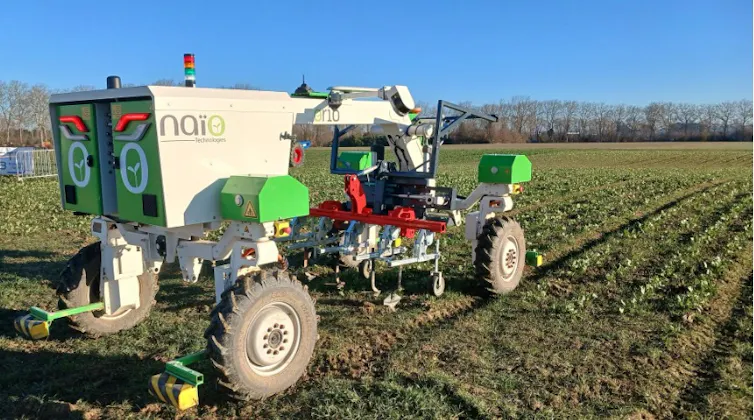
Selective weed control is the most obvious example. Rather than treating an entire area, the robot targets each plant as closely as possible—either mechanically, through targeted spraying, or by applying heat to the weeds. This precision helps limit the use of chemical inputs and reduces the risk of contamination spreading to the environment.
Lighter robots can also help limit soil compaction, a major problem caused by the repeated passage of heavy machinery. Small machines, such as certain seeding robots, can be deployed in fleets on a single plot, thereby distributing the load rather than concentrating it.
The value of agricultural robots extends beyond the automation of farming operations. By regularly monitoring fields, robots can help optimize management practices. They are capable of identifying areas of water stress, detecting certain diseases, tracking crop growth, and providing information useful for decision-making. Deployed on a large scale, they could thus contribute to the establishment of comprehensive agronomic monitoring networks capable of quickly flagging certain anomalies and improving crop monitoring.
But in the field, caution is called for. Most current robots are still designed for relatively simple environments: regular rows, homogeneous crops, and well-structured plots. Yet agroecology relies precisely on diversity: long crop rotations, intercropping, agroforestry, hedgerows, cover crops, and more heterogeneous landscapes. Under these conditions, a robot that performs well in neatly aligned monocultures can quickly reach its limits in more complex systems.
What Surveys of Farmers Reveal
To better understand what motivates farmers to adopt agricultural robots, our InTerACT research unit conducted a survey of 281 farmers. Our analysis, drawing on agricultural and human sciences, aimed to assess the role of farmers’ perceptions and their social environment in the decision to adopt—or not adopt—these technologies.
The main takeaway is clear: farmers don’t adopt a robot because it’s “futuristic,” but because they find it useful. This perceived usefulness is based on very concrete criteria: the robot’s ability to perform a task correctly, the quality of the work it produces, and the ability to see its benefits in practice.
In other words, it’s not about having a machine that “embodies innovation,” but rather an effective tool. Farmers want to know, for example, if the robot weeds effectively, if it saves time, if it reduces costs, if it’s reliable, and if the investment is profitable.
Ease of use also plays a role, but it remains secondary: a simple interface does not make up for a machine that is ill-suited to real-world conditions. Social influence also exists, but to a limited extent: interest from peers or advisors may spark curiosity, but it is not enough to change the assessment of usefulness. Therefore, the “new tractor” effect—the enthusiasm generated by the arrival of new equipment, which generally makes users more inclined to use it, take an interest in it, and appreciate its benefits—is less significant.
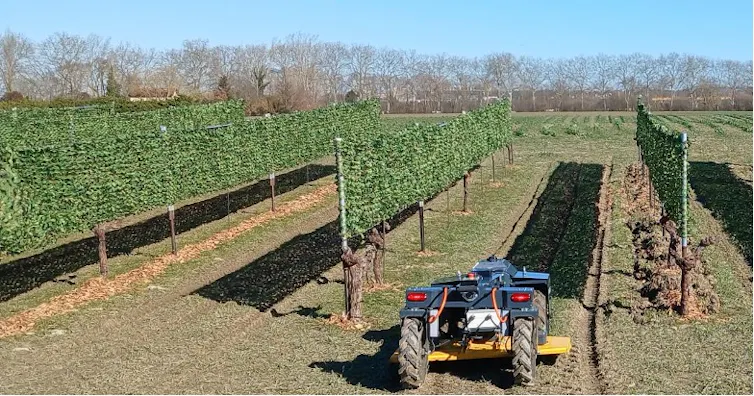
Surveys also show that the adoption of robots is not random. It varies depending on production systems, educational level, and farm structure. Field crops and certain specialized productions—which are more amenable to mechanization—are more conducive to robot adoption, as are partner-owned or collective farms, which often have greater capital resources. Age and experience, on the other hand, play a more limited role.
This observation highlights a central issue: agricultural robotics is not merely a technical matter, but also a question of access. If this equipment continues to be adopted primarily by the best-capitalized farms, the much-heralded “agroecological revolution” risks, above all, widening existing disparities.
Machines That Are Still Limited
Agricultural robots are advancing rapidly, but they still face several limitations. The first is technical: a field is a complex and ever-changing environment. There is mud, rocks, slopes, uneven vegetation, and many unforeseen obstacles. Under these conditions, operating an autonomous machine reliably remains a challenge.
The second limitation is economic. Robots are still expensive, often costing between $50,000 and $300,000 (or between 43,300 and 260,000 euros), not to mention maintenance, training, and the risk of breakdowns. Although they can lead to long-term savings (reduced need for manual labor, more precise use of resources, and greater efficiency in agricultural operations), the investment remains significant and risky for many farms. Cost is currently a barrier to adoption, but its significance must be put into perspective, as learning and economies of scale associated with the widespread adoption of the technology could lead to a gradual decrease in unit costs.
The third limitation concerns work organization. Adopting a robot isn’t just about buying a machine—it also means changing habits, schedules, and skill sets. It also raises new questions, particularly regarding the use of the data generated and potential dependence on manufacturers or proprietary software.
Finally, there is a more political dimension. For robotics to be truly integrated into agricultural systems—particularly the most sustainable ones—it must be accompanied by real-world demonstrations, training, collaborative solutions, locally based maintenance services, and farmer involvement in its design.
Toward a more humane or more automated agriculture?
The question is not so much whether robots will replace farmers—an idea that belongs more to the realm of fiction than reality—but rather understanding what kind of agriculture they are helping to shape.
Depending on the conditions under which they are developed, two trajectories are emerging. In the first scenario, robots extend the logic of industrial agriculture: expansion of farmland, standardization of practices, data collection, and increased dependence on technical systems.
In another context, they can become tools that support more diverse, precise, and less burdensome systems, while facilitating more refined and environmentally friendly practices.
Alternative approaches are emerging: robots shared among multiple users, cooperative fleets, open-source tools, and systems tailored to more complex setups. But these approaches are still in the minority.
However, this prospect remains conditional. The agroecological potential of agricultural robots does not stem from the technology itself, but from how it is integrated into production systems. Depending on the context and the objectives pursued, these technologies can support a reduction in inputs and better harnessing of ecological processes, or they can primarily serve technical and economic efficiency goals. They can also transform the organization of work, redistribute skills, and create new dependencies on digital infrastructure and the actors who control it.
A revolution—provided we choose our course
Agricultural robots may herald a new agricultural revolution. But a revolution is not measured by the number of sensors it carries. It is measured by what it actually transforms: work, soil, economic dependencies, biodiversity, farmers’ autonomy, and, above all, its ability to foster sustainable agriculture.
For now, robots represent less of a paradigm shift and more of a crossroads. They can help build a more agroecological and sustainable agricultural system, but only if their adoption is planned in collaboration with farmers—and not just for them. Robots are also made of metal, plastic, rare metals, and so on. How can we integrate these materials, recycle them, and limit obsolescence if this model were to one day become the standard for all of agriculture?
Mohammad Naim, Doctoral Researcher, University of Technology of Compiègne (UTC); UniLaSalle
This article is republished from The Conversation under a Creative Commons license. Read the original article.


