Cereal varieties that, on average, yield the highest harvests are often favored. But climatic variations and increasing uncertainties are challenging this paradigm.
Wheat, barley, corn, rice… These crops provide nearly half of the world’s caloric intake, making their adaptation to climate change crucial.
But as droughts, late frosts, and heat waves become more frequent, a question arises: which varieties should we choose to cope with increasingly unpredictable conditions?
Because not all varieties react the same way: some see their yields drop rapidly under stress, while others compensate better and maintain more stable performance. Choosing which varieties to select and grow is therefore both difficult and crucial for ensuring food security.
Should we focus on a top-performing variety under specific climatic conditions or on more robust profiles capable of withstanding unpredictability? How can we precisely identify the climatic factors that will govern this performance and stability? These questions are at the heart of our work to generate new insights for plant breeding and enhance the relevance of variety selection.
Average Performance and Its Limitations
For decades, variety selection has relied on trials conducted at multiple locations over several years. Performance data from these trials is analyzed to select new varieties or reinforce recommendations for existing ones, such as the varieties Chevignon, Intensity, and Prestance for soft wheat, and Planet, Timber, and Lexy for spring malting barley. Historically, and still very often today, these decisions are made by looking at the average performance across the entire or a large portion of the trial network, and by recommending the varieties with the highest average performance.
The problem is that, in a rapidly changing climate that appears increasingly unpredictable, this average performance value is misleading, as it does not sufficiently account for the differences in relative performance of the various varieties in response to climatic variations and variations in soil factors. Even more surprising: the climatic factors that determine yield levels are not always the ones that cause changes in ranking among varieties. In other words, the climatic conditions that cause crop yield to vary are not necessarily those that favor or disadvantage certain varieties relative to others, thus revealing the full complexity of crop adaptation to climate instability and the challenges it poses for plant breeding.
A variety that performs very well in one year—reaching, for example, 9 tons per hectare (t/ha) for wheat—may experience a significant drop in yield the following season, to 6–7 t/ha, while being relegated in the ranking by varieties better adapted to the climatic conditions.
Given this observation, we therefore sought to take a different approach. Rather than treating each year or each site as an isolated case, we aimed to identify the major types of climatic and agronomic conditions that crops face, as well as their frequency of occurrence, even though their sequence remains difficult to predict.
Using environmental profiling to better understand the unique characteristics of each location and variety
These conditions are described based on key variables—temperature, water availability, sunlight, etc.—analyzed during the most critical stages of the crop cycle, such as the period from sowing to emergence, from flowering to the start of grain filling, or from grain filling to maturity. This crucial breakdown first allows for a better understanding of the contrasting responses of varieties under different conditions and, secondly, enables the grouping of years and locations into families of historically comparable environments: this is the principle of environmental profiling.
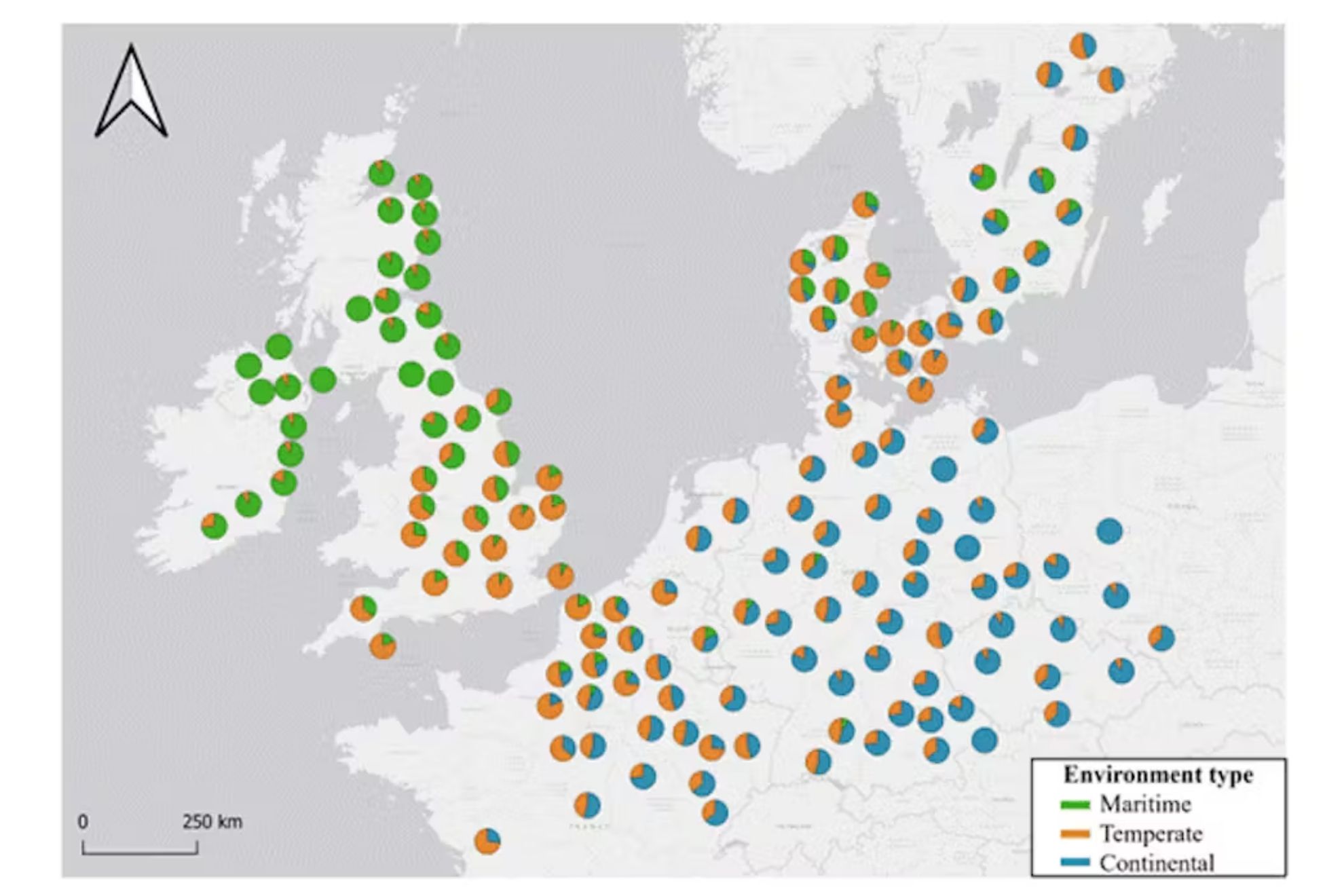
When applied to spring barley, this approach highlights three major types of environments in Europe, defined based on climatic factors that explain the contrasting responses of varieties within the trial network: maritime, temperate, and continental.
Their frequency varies greatly by region. In Ireland or Scotland, the climate is overwhelmingly maritime from one year to the next. Conversely, in northern France, these types frequently alternate (Figure 1), which directs selection and variety choice toward genotypes with broader adaptability—that is, those capable of performing well on average across contrasting conditions. In Ireland and Scotland, it would therefore be wise to focus on a top-performing variety for specific conditions, whereas in northern France, it would be better to favor a robust variety to cope with unpredictability.
The analyses also show that cool temperatures early in the growth cycle, between emergence and the “1 cm ear” stage—the latter corresponding to the start of the future ear’s development within the stem—can maximize the yield potential of the tested spring barley varieties. Furthermore, the intensity of solar radiation during the grain-filling phase of barley induces contrasting responses depending on the variety. These results provide valuable insights for guiding breeding strategies.
Winter soft wheat yields are stagnating
Winter soft wheat is also a key focus. As the world’s most widely grown cereal, it has benefited from steady genetic progress since the late 1980s, but its yield stability remains fragile, with average levels hovering around 7.5 t/ha since the late 1990s. Interactions between varieties and environments play a major role in determining yield levels, which also vary regionally.
Envirotyping makes it possible to identify the major climate scenarios responsible for variations in yield and quality, and to define zones of general or specific adaptation. An important lesson is that the highest-performing varieties are not necessarily the most stable in terms of yield: genetic progress has not automatically increased climate resilience.
This research converges on a single message: understanding the climate is no longer enough; we must manage its unpredictability. By structuring the environments actually encountered by crops, envirotyping offers an approach that is both scientific—to improve knowledge by highlighting the plant traits involved in adaptation to climate change—and pragmatic—to adapt variety selection today to the climate of tomorrow.
Results that must be incorporated into decisions about farming practices
In the face of an increasingly unstable climate, it is no longer sufficient to base variety selection on average performance. By mapping the diversity of actual climatic conditions encountered by crops, envirotyping provides a better understanding of why varieties behave differently from one year or context to another, and helps guide breeding toward profiles that are more resilient to unpredictability.
However, this approach remains based on trials conducted under often favorable conditions (optimal soil texture, structure, and depth) and using very conventional agricultural practices. The challenge will therefore also be to incorporate the impact of these practices—sowing dates, tillage, fertilization, and crop protection—using data from the field and agricultural traceability.
By structuring this information with and for farmers, it will pave the way for more realistic variety recommendations, combined with farming practices better suited to the diversity of agricultural systems and the constraints of tomorrow’s climate.
This article was supported by Chloé Elmerich and Maëva Bicard as part of their doctoral dissertations conducted at the AGHYLE research unit (Agroecology, Hydrogeochemistry, Environments and Resources, UP2018.C10)at the UniLaSalle Polytechnic Institute.
About the Authors
- Bastien Lange, Assistant Professor of Plant Sciences and Agroecology, UniLaSalle
- Michel-Pierre Faucon, Assistant Professor of Plant Ecology and Agroecology, Associate Director of Research, UniLaSalle
- Nicolas Honvault, Researcher in Agroecology, UniLaSalle