Field experiments using meadows covered with Plexiglas or 25-meter-wide carbon rings, the creation of miniature ecosystems in the laboratory, the use of historical data, satellite monitoring, and mathematical models… To understand how climate change will affect ecosystems, there are many methods, and they often complement one another.
“Manage the inevitable to avoid the unmanageable.” At a time when the effects of climate change are only growing everywhere, this is the common phrase used by climatologists to express, in very concrete terms, the strategic objective of climate policies.
Faced with these troubling predictions, ecologists observe and seek to understand this phenomenon in order to better predict its consequences for our ecosystems.
There are various approaches to testing how climate change affects organisms, their interactions with one another, between species, and with their environment. These combine observations, experiments, and modeling. Here is an overview of these different approaches implemented in France and around the world.
Full-scale experimental platforms
One initial approach involves modifying an ecosystem via equipment and studying the resulting changes. Whether the goal is to assess drought, rising temperatures, or increased atmospheric CO2 levels, the principle remains the same. This allows us to control one or more environmental variables (precipitation, temperature, and others) as if we were under future conditions, to simulate upcoming climate scenarios.
This is the case with the Puéchabon platform in southern France, or the DRI-GRASS platform near Sydney, Australia. Both aim to understand how a change in rainfall patterns impacts the ecosystem and its functioning, but in two very distinct ecosystems.
In Puéchabon (Hérault), a system of gutters in a holm oak forest partially excludes rainwater to simulate drought. This experiment began in 2003, with four 140-square-meter plots in the holm oak forest. This allows researchers to assess the effect of drought on entire forest plots. What are the effects on the forest, on the trees, on the soil? What are the effects on carbon storage?
In Sydney, the DRI-Grass platform uses a similar system in a different type of ecosystem: a grassland. Instead of gutters, Plexiglas roofs cover different parts of the grassland. This more recent experiment began in 2013 and covers just over 120 m2.
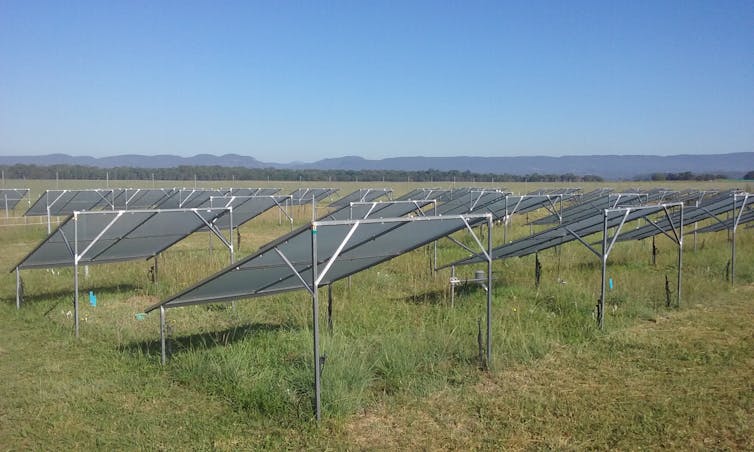
In addition, an irrigation system simulates several possible scenarios: an increase, decrease, or change in rainfall distribution. This allows researchers to study scenarios involving extreme events, such as less frequent but heavier rainfall. Researchers can therefore modify water regimes to align with future climate prediction scenarios. One of us worked on this platform for three years to better understand the response of fungi and their interaction with plants in the face of climate change.
Also in Australia, but far more impressive in scale and scope, the EucFACE platform tests the effect of rising atmospheric CO2 levels. Here, carbon-fiber rings encircle circular plots of eucalyptus forest 25 meters in diameter and 28 meters tall!

During the day, these rings release CO2 into the forest to simulate a rise in CO2 levels to 550 ppm, the concentration expected in the atmosphere by the year 2050. Many researchers are working on this platform to understand how rising CO2 levels might disrupt the functioning of Australia’s native forests.
For a more realistic simulation of future changes, some platforms combine multiple factors. The Austrian ClimGrass platform, for example, tests not only rising CO2 levels but also temperature and drought. This platform, now in its tenth year, focuses on the impacts of climate change on a grassland.
Regardless of the platform and the scenario being tested, researchers from various disciplines are working together and taking measurements to study the effects of climate change on organisms (plants, soil organisms, herbivores, and others), species diversity, and ecosystem functioning (such as its ability to sequester carbon).
One of the challenges associated with this experimental approach is the multitude of factors that cannot be controlled in an open-air experiment. Results can vary from year to year depending on very real on-the-ground variables (such as an exceptionally rainy year). Furthermore, these studies are generally more expensive and require more maintenance.
Creating and monitoring a mini-ecosystem: microcosms
For more controlled conditions, other projects involve setting up scaled-down ecosystems in the laboratory. For example, a terrestrial microcosm may contain either artificial assemblages of organisms (a selection of potted plants) or portions of an ecosystem taken from the environment (soil and plants extracted from a meadow or similar site).
These mini-ecosystems are then placed in climate chambers. These chambers vary in size but can be as small as two cubic meters. They confine communities of organisms and expose them to environmental variables (temperature, humidity, CO2…) simulating climate change scenarios under fully controlled conditions.
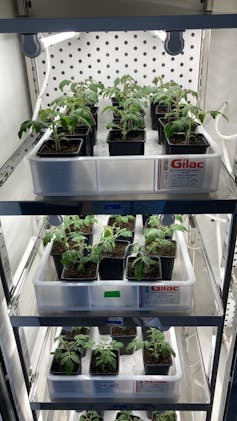
This type of experiment has the advantage of providing an environment that facilitates interpretation and monitoring. For example, simulating a rise in temperature while keeping other parameters (humidity, CO2, etc.) constant and precisely controlled. This allows us to isolate and interpret the effect of temperature—and temperature alone—on the microcosm. Thus, microcosms represent only a portion of the ecosystem and differ from more fluctuating and realistic conditions.
Taking Advantage of Natural Gradients
Rather than altering the ecosystem or isolating a part of it, some researchers make use of natural gradients—that is, the natural variations found in nature. In terrestrial ecosystems, for example, temperature gradients occur with altitude in mountainous regions. The higher the altitude, the lower the temperatures. A temperature gradient also exists based on latitude. Generally, the closer one gets to the poles, the colder the temperatures become. And, more recently utilized, there are also temperature gradients between rural and urban areas with their heat islands.
Thus, the impact of temperature can be assessed by following a transect (virtual line) along the gradient, but not only that.
There are “translocation” experiments, in which researchers move either species or entire communities from high-altitude mountain areas to lower-altitude areas to simulate warming. For example, researchers have moved 0.7-meter-by-0.7-meter grassland plots to three different elevations in the Alps: 950, 1,450, and 1,950 meters above sea level. Following these transplants, regular monitoring can be conducted to study the plants, their abundances, and associated species.
Another type of experiment involves moving an organism to higher-elevation areas, which are currently colder. These areas, currently inaccessible to organisms from lower elevations (where temperatures are milder), will become suitable for their growth as a result of global warming. The purpose of these studies is to measure the impact of these future migrations on ecosystems where these species are currently absent.
Although informative, these experiments also have their biases. The temperature gradient is a key factor, yet there is a myriad of other environmental factors that vary along these gradients. These factors cannot be controlled, but they can still be taken into account when interpreting the researchers’ observations.
Long-term monitoring and measurements
Some ecosystems have been studied for a very long time. This is the case of the Hubbard Brook Experimental Forest in New Hampshire, in the northeastern United States. Environmental measurements and data on associated species have been collected since 1955 (that’s seventy-one years this year!). In France, the Chizé Biological Research Center has been conducting research on the evolution of wild animal populations since 1968.
This allows us to correlate meteorological data with species activity, abundance, and diversity. The data not only enable us to directly observe climate change over the past decades but also how the variability of weather events influences ecosystem functioning.
Another way to obtain long-term measurements and conduct large-scale monitoring is through citizen science. Whether in a garden, in the city, or while hiking, species observation data allow us not only to record the presence of a species but also its phenology—that is, how climate influences the seasonality of species.
These fluctuations are also highlighted through historical records. This is the case with the date of cherry blossom blooming in Kyoto, whose records date back to 853. Or, closer to home, records of harvest dates, which show that harvests have advanced by an average of two to three weeks.

This type of project helps answer several questions, such as: Is spring starting earlier and earlier? Is the species’ geographic distribution changing? Which ones are most affected?
Monitoring from space
Continuous, daily measurements covering the entire Earth’s surface from space to better understand Earth’s systems and improve prediction models. Among the many applications of this tool, it enables, in particular, the mapping of vegetation, its health, and its ability to sequester CO2.
Modeling
Modeling is an essential practice in science, allowing for the simplified representation of a system—in this case, an ecosystem. These models can take many different forms, ranging from simple mathematical equations to complex models based on a large number of parameters (climatic, pedological, biological, and others).
A very telling example of the use of modeling is forest fire forecasting. This allows us to predict how climate change affects the intensity, duration, and extent of fire seasons. These models are all the more important because they also help identify forests that have so far been spared but will be affected by climate change.
Once fire risks are estimated, these predictions can be combined with field observations: which species are present? Are they adapted to fire? Simulations also allow us to examine the establishment and extinction of different species in relation to fire and the environment.
Generally speaking, models can be adapted to different ecosystems (forests, grasslands, lakes, oceans…), model species, and climates (temperate, tropical…). As our technologies advance, these models become increasingly effective. Although complex, these methods are powerful tools for exploring the consequences of climate change and open the door to a whole range of possibilities.
Regardless of the approach used by researchers, all these tools and methods are complementary. Each contributes to the development of operational scientific knowledge for mitigating the causes of climate change and adapting to its already observable effects.
About the Authors
- Coline Deveautour, Assistant Professor of Soil Microbial Ecology, UniLaSalle
- Pierre-Yves Bernard, Assistant Professor of Agronomy – Director of the Agrobiosciences College – Research Associate at UR AGHYLE, UniLaSalle