Humans aren’t the only ones with microbiomes. Plants have them too. The thousands of microorganisms living on their leaves are still poorly understood, but they hold great potential for boosting plant growth, improving crop yields, and enhancing stress tolerance.
At a time when the use of pesticides and synthetic fertilizers is increasingly being called into question, effective alternatives must be found. Among the solutions currently being explored, the use of naturally derived products—also known as biosolutions—is showing promising results.
Biostimulants are among these alternatives. They can come from various sources and contain, for example, algae extracts, microorganisms such as fungi or bacteria, plant extracts, amino acids, and more. They are applied in a variety of ways, including spraying them on leaves, coating seeds, or applying them directly to the soil.
These products work by stimulating plants’ natural biological processes to improve their nutrition, growth, yield, or stress resistance. Whereas a fertilizer directly provides a nutrient (such as nitrogen, phosphorus, or potassium) that promotes plant growth, and a pesticide is used to eliminate plant pests, biostimulants enable the plant to enhance its own capabilities.
What are the benefits of using foliar biostimulants?
There are several advantages to using foliar treatments rather than soil treatments.
First, these treatments take effect more quickly because the solution acts directly on the plant’s metabolism, without being overly dependent on the complex environment of the soil. Furthermore, the doses used in foliar treatments are much lower than those used in soil applications, making these treatments more cost-effective.
In addition, it is common to apply this type of treatment in combination with other foliar treatments (herbicides, fungicides), whose negative effects appear to be offset by the biostimulant’s benefits.
How do biostimulants influence plant microbiomes?
Another reason biostimulants are particularly interesting is their ability to interact with plant microbiomes. After all, humans are not the only ones living in close contact with a myriad of bacteria, fungi, and other microorganisms that perform important functions.
The organisms present in plant microbiomes include:
- bacteria (single-celled microorganisms without a nucleus);
- archaea (single-celled microorganisms without a nucleus that form a distinct kingdom separate from bacteria);
- multicellular fungi that produce mycelium;
- unicellular fungi (such as yeasts);
- algae (unicellular plants) and protists (unicellular cells that cannot be classified within the animal, plant, or fungal kingdoms);
- viruses and bacteriophages (viruses that exclusively attack bacteria).
In plants, these microorganisms are found in particular in the soil, roots, and above-ground parts (stems, leaves, fruits, and flowers).
Biosolutions or chemical control products come into direct contact with these microorganisms, which constitute the plant’s microbiome.
Several studies have already demonstrated the impact of biostimulants on the microbiome in roots and soil. These soil and root microorganisms are collectively referred to as the rhizosphere. Biosolutions applied to the soil are, for example, capable of modifying soil microbial communities, notably by increasing the abundance of mycorrhizal fungi (fungi known to improve nutrient uptake by plants, which are believed to promote crop growth and yield).
Unfortunately, at present, few studies on microorganisms present in the above-ground parts of plants—also known as the phyllosphere—have been documented. Yet we know that these microorganisms have an overall positive effect on host plants and are directly influenced by products applied to the leaves.
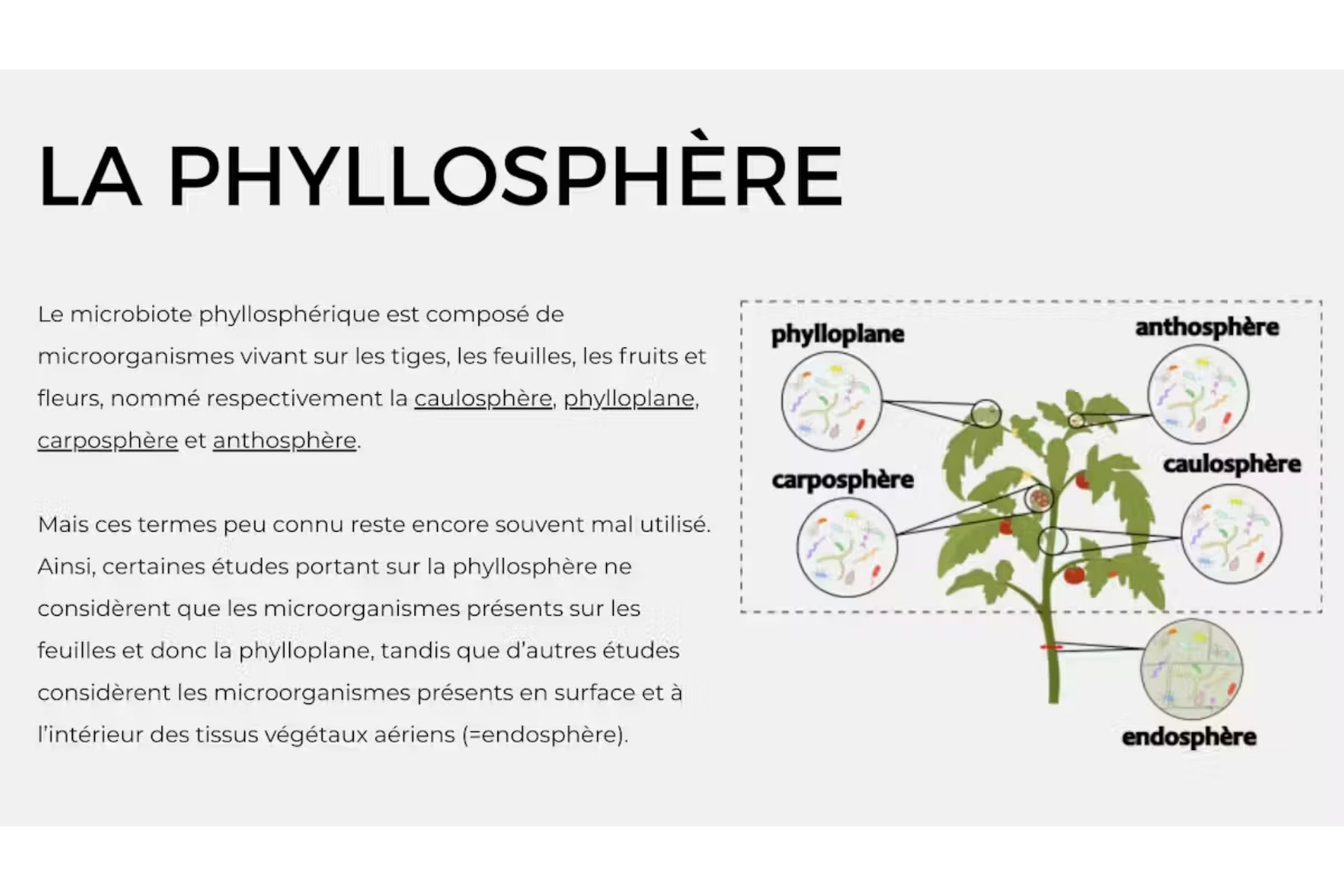
Within the phyllosphere, microorganisms are capable of interacting with one another as well as with their host plants, with which they maintain a symbiotic relationship—that is, a biological, long-term, and mutually beneficial association between two living organisms.
As a result, this microbiota plays an important role in plant development and nutrition. Furthermore, as observed with the human skin microbiota, the presence of microorganisms on the surface of above-ground plant parts allows the plant to protect itself and prevent attacks by pathogenic organisms. For example, a study shows that certain members of the microbial community on leaves provide significant protection against a pathogen in chickweed, a very common flowering plant in Europe.
But to better understand the full potential of the beneficial alliances taking place on plant leaves—there’s no mystery here—we need to learn more about them and study them.
Étudier la phyllosphère
Pour étudier les microbiotes, on analyse généralement l’ADN des microorganismes.
Metagenomics is an analytical method based on DNA sequencing (determining the base sequence of all genes in the genome) of a given environment. With this method, it is possible to study the predominant microorganisms in a specific environment by identifying them and comparing their sequences with those of microorganisms already identified in databases known as BLAST. Metagenomics also allows us to understand the functions performed by these microorganisms. These techniques, which are currently very popular, are used because they have the advantage of not relying on the culturing of microorganisms, which can sometimes be very difficult or even impossible.
However, DNA-based studies cannot distinguish between the DNA of dead and living microorganisms or determine whether these microorganisms are active. At the AGHYLE laboratory, the phyllosphere microbiota is therefore studied in parallel by culturing certain microorganisms in Petri dishes, although these represent only a few percent of the total microbiota.
The bacteria obtained and isolated from the phyllosphere generally exhibit a wide variety of colors, textures, and appearances. Coloration allows microorganisms to better withstand UV radiation, which is a selective advantage, as they must be able to withstand sunlight unlike those in the rhizosphere. Some bacteria form very mucoid (oily) colonies, which also makes them more resistant to drought.

Several studies indicate that microorganisms from the phyllosphere exhibit beneficial activities for plants. For example, Methylobacterium bacteria found on the phyllosphere are known to stimulate plant growth and protect plants from pests.
Other bacteria isolated from the phyllosphere of tomatoes, such as Bacillus velezensis 83, also possess the ability to stimulate plant growth and protect crops.
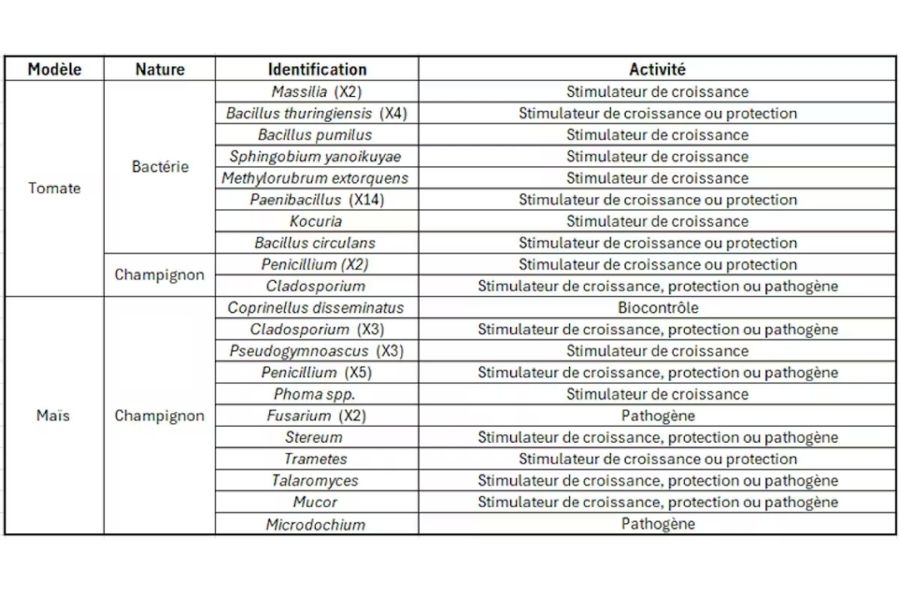
In the laboratory, we identified bacteria and fungi isolated from the phyllosphere of the tomato Solanum lycopersicum (MicroTom variety) and corn (Zea mays L., DATABAZ variety). By comparing the obtained DNA sequences with an international database (BLAST), we were able to identify the genus and, in some cases, the species of these microorganisms and verify that they were indeed known microorganisms originating from the phyllosphere.
Among the identified microorganisms, several are known in the literature and may belong to plant-growth-promoting bacteria or fungi and/or exhibit biocontrol effects. Others are only partially identified, and we therefore cannot yet determine whether they are beneficial or pathogenic.
Although it is possible to use bacteria or fungi isolated from the natural environment directly to boost plant growth and protection, the colonization and ability of microorganisms to function in the field remain difficult to predict.
Furthermore, storing microorganisms is far more complicated than storing a biostimulant. In this regard, developing solutions that act directly on microorganisms already present on plants remains a promising alternative for agriculture. Thus, to test biostimulants quickly and cost-effectively, we conduct in vitro tests (in Petri dishes) in the laboratory on microorganisms in the phyllosphere. The development of the microorganisms is monitored over time, and the morphology of bacterial and mycelial growth is observed.
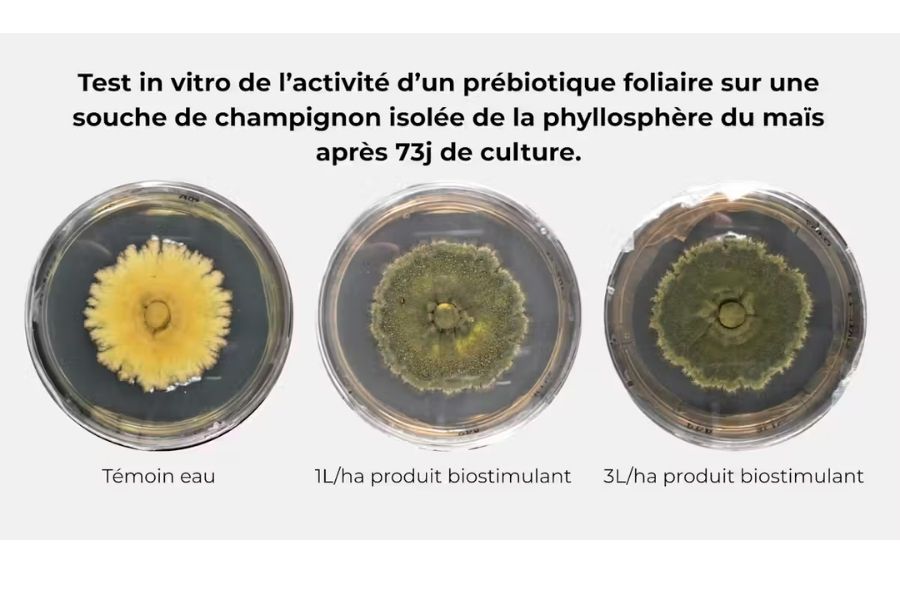
The figure above shows the effect of a foliar biostimulant on a fungus isolated from the maize phyllosphere. Although the size of the mycelium does not appear to be affected, the presence of the biostimulant seems to influence the fungus. However, several questions remain unanswered: does this biostimulant have the same effect on all microorganisms in the phyllosphere? Will it not stimulate the growth of pathogenic organisms?
These preliminary results offer interesting prospects, but require further investigation.
About the authors
- Mathilde Bouteiller, research fellow in microbiology and molecular biology, AGHYLE unit, UniLaSalle
- Guillemette Garry, assistant professor of biology (plant pathology track), affiliated with the AGHYLE research unit, UniLaSalle