The European C5 project (Carbon Conversion Cycles: From Cultivation to Construction) explores how crops and agricultural residues can be transformed into fibers, bio-based materials, and biochar. It is developing circular value chains that connect rural and urban areas, with the goal of reducing the construction sector’s environmental footprint.
In Rennes, UniLaSalle is leading a phytoremediation demonstration project on former mining sites in Pont-Péan.
With the support of the European Union

- Project Leader: University of Kassel
- Partners: University of Kassel (DE), Blended Learning Institutions Cooperative (DE), BAFA Hempfoods GmbH (DE), Artevelde University of Applied Sciences (BE), UniLaSalle, Irish Bioenergy Association (IR), Lean Green Management Solutions (IR), Municipality of Enschede (Netherlands), Planete Chanvre (FR), ValBiom (BE)
- Project duration: 36 months (2026–2029)
- Total project budget: €4 million
- Budget for UniLaSalle: €340,000
Introduction and Project Background
Rural areas in northwestern Europe face major challenges related to a lack of economic opportunities due to declining agricultural production and environmental degradation. Urban areas are confronted with the construction sector’s significant carbon footprint, which accounts for 5–12% of total greenhouse gas (GHG) emissions.
The C5 project addresses these challenges by harnessing the potential of the circular economy in rural and urban areas: rural areas supply agricultural products to the construction sector in the form of bio-based materials.
C5 creates synergies between agricultural production and applications in the construction sector, integrating rural and urban economies to create new value chains that increase incomes and reduce environmental impacts.
Depending on the quality of the materials, they are processed as follows:
- high-quality fibers for structural components,
- insulation materials,
- or biochar for construction and adsorbent substrates.
C5 also manages soil phytoremediation to restore degraded soils in rural and peri-urban areas within the project regions, focusing on the following issues:
- PFAS contamination (Germany/Belgium)
- Pesticide and nitrate pollution (Netherlands, Belgium, Ireland)
- Heavy metal contamination (France)
Research and Demonstration Project - Brittany, France
Is it possible to remediate contaminated soil while also utilizing the biomass produced?
A Local Project to Address a Legacy from the Past
The town of Pont-Péan is known for its mining history. While this industry contributed to the area’s history and development, it has also left its mark on the environment. On some plots of land, the presence of metals in the soil now limits certain agricultural uses and raises questions about their remediation.
To address this challenge, the town of Pont-Péan and UniLaSalle are leading an innovative project aimed at testing a natural solution: phytoremediation using fibrous plants (miscanthus, hemp).
What is phytoremediation?
Phytoremediation involves using plants to help restore degraded or contaminated soils. Certain species are capable of absorbing, stabilizing, or limiting the mobility of specific pollutants present in the soil.
Industrial hemp is particularly well-suited for this approach. This plant grows rapidly, produces a large amount of biomass, and adapts to various soil types. It could thus contribute to environmental restoration while creating new economic opportunities related to its cultivation.
Why hemp?
Hemp is already used in many fields:
- Insulation and Building Materials
- Textiles and Technical Fibers
- Bio-based Materials and the Circular Economy
- Carbon Sequestration and the Green Transition
This plant could also help researchers better understand the behavior of pollutants found in certain soils.
Real-world testing in Pont-Péan
Experimental plots have been established in Pont-Péan to observe how hemp behaves in soils with varying levels of contamination. The experiment aims to study:
- Plant growth on contaminated land;
- The presence of metals in different parts of the hemp plant;
- Changes in soil quality over time.
This research will provide a better understanding of hemp's true potential in the restoration of the affected lands.
What happens after the harvest?
Simply growing a plant in contaminated soil is not enough: we must also control what happens to the harvested biomass.
Researchers will therefore analyze the different parts of the plants separately to determine where the metals are concentrated.
If certain fractions—particularly the fibers—have concentrations compatible with safe uses, their application in bio-based materials may be explored.
For more heavily contaminated fractions, other options will be evaluated, particularly thermochemical conversion into biochar. The resulting biochars will in turn be characterized to assess the concentration, mobility, and risk of metal leaching.
An experiment to prepare for the future
Phytoremediation is not a miracle solution: the demonstration project must precisely determine under what conditions it can contribute to the management of contaminated soils and what limitations must be taken into account.
The results obtained could serve as a model for other regions facing similar challenges in Brittany and elsewhere in France. Through this initiative, Pont-Péan is becoming a true open-air laboratory for developing the environmental solutions of tomorrow.
A Project That Benefits the Community
Beyond scientific research, the project aims to bring together local stakeholders: the municipality, residents, farmers, organizations, businesses, and researchers.
The goal is to explore new possibilities for land that is currently underutilized, while contributing to the ecological transition and the development of a local circular economy.
The Next Steps for the Demonstrator
Summer 2026: Growth and monitoring of experimental plots established on former mining sites.
Observation of the plants' growth and their adaptation to local soils.
Mid-September 2026: hemp harvest
- Harvesting mature plants.
- Preparing samples for laboratory analysis
Fall–Winter 2026: Laboratory Analyses
- Soil samples from cultivated and uncultivated areas.
- Separation of the different parts of the plant:
- Roots,
- Stems,
- Leaves,
- Seeds (if present).
- Interpretation of the results.
Several key questions will remain to be answered:
- Does hemp absorb pollutants from the soil?
- Where do these pollutants accumulate in the plant?
- Are there parts of the plant that remain minimally or not at all contaminated?
If the analyses show that the fibers contain few pollutants, their use in certain applications—particularly in the construction sector—could be considered. Otherwise, other appropriate recovery options will be explored to ensure environmental protection and user safety.
Winter 2026–2027: Cover crops will ensure that the plots are prepared for the new season. For this purpose, it was decided to sow a mixture of rye and vetch, as well as white mustard.
April–May 2027: Preparing the plots for the next phase of experiments
The experiment will continue with hemp, sorghum, and miscanthus.
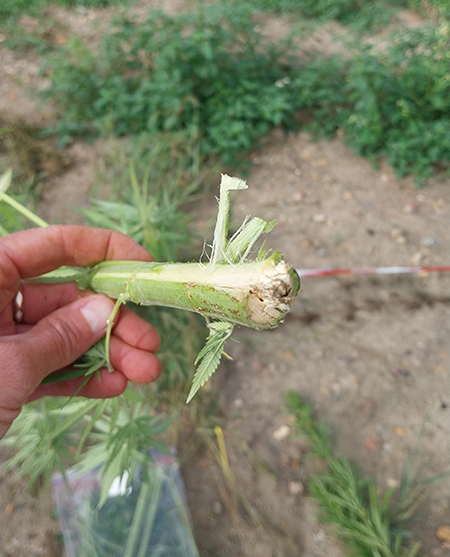
The questions the project must address
- Does hemp absorb pollutants from the soil?
- Are the pollutants found throughout the entire plant, or only in certain parts?
- Can hemp fibers be safely recycled?
The answers to these questions will help guide future uses of the biomass produced.
Did you know?
- Hemp can produce a significant amount of biomass in just a few months.
- Metals are not necessarily distributed in the same way among the roots, stems, leaves, and seeds.
- This distribution is key to determining whether certain parts of the plant can be utilized.