


The UniLaSalle engineering school and GRDF are renewing the “Agricultural Anaerobic Digestion and Transitions” teaching and research chair for four years and are signing a framework agreement designed to structure new research and innovation projects. This partnership aims to train future leaders in the energy transition and to develop concrete solutions to benefit agricultural regions.
“For several years now, UniLaSalle and GRDF have shared the conviction that agricultural anaerobic digestion is a driver of innovation that should be studied and supported to enhance the resilience of agricultural production systems and facilitate regional transition. “The renewal of this partnership reflects our commitment to going further by combining the expertise of UniLaSalle’s scientists with that of GRDF to address the agricultural, energy, and environmental challenges of tomorrow,” emphasized Philippe Choquet, CEO of UniLaSalle.
“The agricultural sector plays a vital role in the development of renewable energy, foremost among which is the production of biomethane—a local, domestically controlled energy source that creates value in regional communities. “I am pleased to sign this research and education partnership, which will help train the talent the industry needs. These young people will be the key players in the energy transition of our regions tomorrow,” said Stéphane Gorisse, Director of Green Gas Development at GRDF.
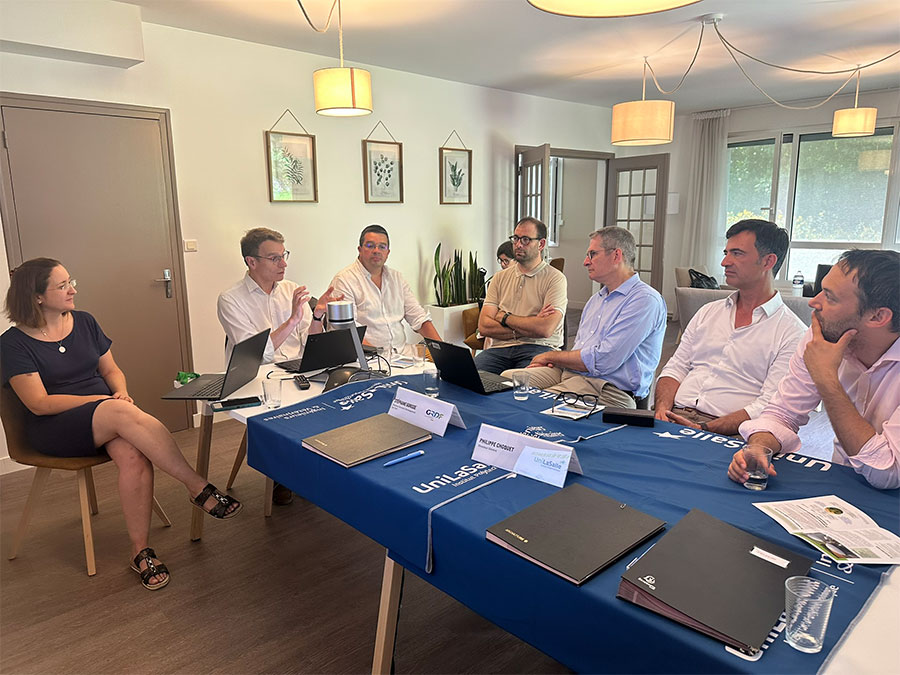
An integrated and multidisciplinary approach to supporting the energy transition
The “Agricultural Anaerobic Digestion and Transitions” Teaching and Research Chair aims to train stakeholders in the agricultural energy transition and to accelerate applied research on anaerobic digestion. It is aimed at a broad audience—engineering students, agricultural professionals, and local governments—and promotes an integrated approach to energy, agronomic, and regional issues. Its research shows that the success of anaerobic digestion projects depends as much on their social acceptability—based on information, participation, and perceived fairness—as on their technical and agronomic performance. Since its creation in 2022, dozens of students have been trained.
The newly signed framework agreement will make it possible to harness the school’s multidisciplinary expertise—in agronomy, bioprocesses, economic and social sciences, and digital technology—to develop innovative research projects aimed at advancing biogas production and the transition of agricultural systems.
Bringing Research and Farmers' Needs Closer Together
Since its founding, UniLaSalle students have been developing practical projects aimed at bridging the gap between research and the field and providing tools that are directly useful to farmers in improving their agro-environmental performance. Among these projects is the development of a tool for assessing the fertilizing value of digestate. Depending on the type of site and inputs, this tool makes it possible to optimize farms’ nitrogen self-sufficiency—or even make them entirely self-sufficient—thereby reducing reliance on chemical fertilizers.
All of this work has been shared with the industry at various trade shows, conferences, and producer events, notably through the Association of French Anaerobic Digestion Farmers and the Chambers of Agriculture.
Knowledge is also being disseminated more broadly through joint awareness-raising initiatives and innovative educational programs. For example, the Agroécologia exhibit, UniLaSalle’s new educational space, has helped raise awareness among more than 900 middle and high school students in the Hauts-de-France and Île-de-France regions about waste recovery through anaerobic digestion.
Learn more about the Chair in Agricultural Anaerobic Digestion and Transitions
About GRDF
GRDF operates the largest natural gas distribution network in Europe. It operates and maintains 209,000 km of networks while ensuring the safety of people and property. GRDF is a key player in an affordable energy transition rooted in local communities. Present in more than 9,500 municipalities, the company partners with local governments to support their decarbonization efforts through energy policies and sustainable mobility choices.
GRDF distributes gas to nearly 11 million customers for heating, cooking, and transportation, regardless of their supplier. For each use, GRDF offers practical solutions to reduce its customers’ carbon footprint: energy conservation, green gas, energy efficiency, and high-performance equipment. The company is committed to achieving 20% green gas in its networks by 2030, a goal that will enable as many people as possible to benefit from renewable energy produced in France.
GRDF is the leading gas distributor on a decarbonization trajectory—across all scopes and on a like-for-like basis—in line with the Paris Agreement.


