Faced with environmental, food and energy issues, profound paradigm shifts must be initiated by societies.
The AGHYLE unit operates within a scientific framework focused on studying the interactions between plants, soil, water, and biodiversity, in response to the current challenges of the agroecological transition.
Its research aims to understand the biological, physicochemical, and ecological processes involved in soil health, plant nutrition, crop productivity, and the resilience of agroecosystems to biotic and abiotic stresses.
This framework aligns with ambitious public policies:
- reducing chemical inputs,
- improving soil and water quality,
- preserving biodiversity,
- and adapting to climate change.
The AGHYLE unit thus develops a systemic and multi-scale approach to sustainable agriculture.
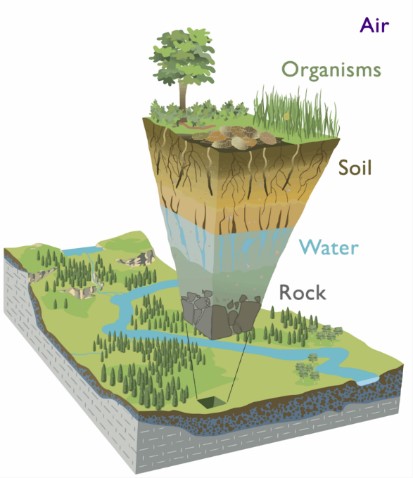
* Diagram of the critical zone (adapted from Chorover et al., 2007)

The AGHYLE Unit’s Focus Areas
The AGHYLE Unit focuses on several key areas:
- Supporting agricultural transitions: by identifying and disseminating innovative agricultural practices that promote soil health, reduce the use of plant protection products, and optimize fertilization.
- Contributing to scientific innovation: through the development of biosolutions, predictive models, and tools for characterizing soils, the rhizosphere, and environmental transfers.
- Training and mentoring: strong involvement in undergraduate education (engineering students), research-based training (master’s programs, theses, postdocs), and continuing education for stakeholders in the agricultural and environmental sectors.
The Scientific Program
The AGHYLE unit’s scientific program is structured around three major complementary research areas:
- Area 1: Soils, Biodiversity, and Ecosystem Services
- Area 2: Soils, Biodiversity, and Plant Health
- Area 3: Soils, Biodiversity, and Global Health
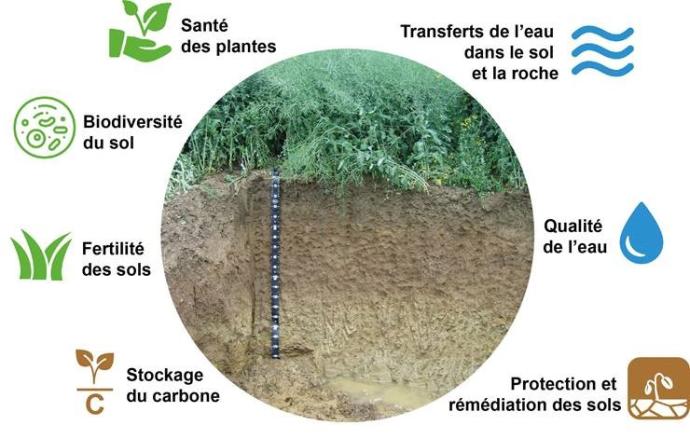
The AGHYLE Unit
The AGHYLE Unit is a key player in agricultural and environmental research, specializing in the study of soil-plant-microorganism interactions and the modeling of material flows in agroecosystems.
It plays a central role in supporting agricultural transitions toward more sustainable practices, at the intersection of scientific innovation, engineering education, and socio-economic partnerships.
Its expertise is based on a multidisciplinary approach, field experiments, and a strong commitment to transferring knowledge to the agricultural sector and public policy.
The team
Permanent staff
AGHYLE Beauvais campus
- ARMAND Romain : Associate professor, surface hydrology (CV HAL)
- AYERDI-GOTOR Alicia: Associate professor, ecophysiology (CV HAL)
- DAMESTOY Thomas : Associate professor, ecology and entomology (CV HAL)
- DULAURENT Anne-Maïmiti Associate professor, ecology-animal, agro-ecology (CV HAL)
- FAUCON Michel-Pierre: Associate Professor, Associate professor qualified to direct research, plant ecology and agro-ecology (CV HAL)
- FIRMIN Stéphane: Associate professor, toxicochemistry (CV HAL)
- GALLOIS Nicolas : Chemical technician
- GUIDET Julien : Research engineer in plant production and experimentation
- HOUBEN David: Associate professor, soil sciences, biogeochemistry (CV HAL)
- JAFEU Léa: Research Technician in Plant Biology
- KERVROËDAN Léa: Associate professor, plant ecology (HAL CV)
- LANGE Bastien: Associate professor, plant ecology, genetics (CV HAL)
- D. MUNAIZ Eduardo : Associate professor in genetics and plant breeding (CV HAL)
- POURRET Olivier: Associate professor qualified to direct research, geochemistry (CV HAL)
- ROISIN Céline : Plant pathology research engineer (CV HAL)
- SAILLET-POURRET Elodie : Associate professor, hydrogeology (reservoirs and resources) (CV HAL)
- SELIM Sameh: Associate professor qualified to direct research, plant pathology and molecular biology (CV HAL)
- UGARTE Carolina: Associate professor, soil science (CV HAL)
- ZOUHRI Lahcen: Associate professor qualified to direct research, hydrogeology (CV HAL)
AGHYLE Rouen campus
- ALAHMAD Abdel-Rahman : Agronomy Research Fellow, Biomes Chair (CV HAL)
- BAILLEUL Caroline : Engineer, analytical chemistry, biochemistry
- BERNARD Pierre-Yves: Associate professor, agronomy, cropping systems
- BOUTEILLER Mathilde, Researcher in microbiology, molecular biology, and microbial ecology of the phyllosphere
- BRESSAN Mélanie: Research coordinator, molecular biology, plant pathology (CV HAL)
- DANTAN Jérôme : Associate professor, IT(CV HAL)
- DEVEAUTOUR Coline : Associate professor, ecology (CV HAL)
- GARRY Guillemette : Associate professor in phytopathology (CV HAL)
- GATTIN Isabelle : Associate professor qualified to direct research, agro-ecology, microbial ecology, biogeochimical cycles (CV HAL)
- GAUTHIER Adrien: Associate professor, phytopathology, plant sciences (CV HAL)
- HANOT-CAUCHOIS Anne : Biochemistry Technician
- LAURENT Nadia: Associate professor, soil, biogeochimical cycles, organic matter (CV HAL)
- LAVAL Karine: UniLaSalle Research Director, qualified to direct research, microbiology, soil sciences (CV HAL)
- LEGRAS Marc Associate professor, soil sciences, agro-ecology, biogeochemistry (CV HAL)
- LEPLET Maëva: Laboratory technician, cell biology, molecular biology
- PEREZ Lisa: Research Engineer, Molecular Biology, Biochemistry (HAL CV)
- RIAH-ANGLET Wassila: Research coordinator, microbial soil ecology, biochemistry, microbiology (CV HAL)
- SAINT JORE-DUPAS Claude : Associate Professor of Cell Biology and Plant Biotechnology (CV HAL)
- TEMAGOULT Mébarek :imaging and cell biology design engineer (CV HAL)
- VELOSO GOMEZ Murilo: Associate professor, international agronomy, soil sciences (CV HAL)
PhD students
- Maroua ALAOUI - “Contribution to the understanding of plant-soil microorganism interactions: a study of microRNA rhizodeposition in wheat, rapeseed, and peas under abiotic stress.” - Thesis defended on December 2, 2025
- Charlotte AMY – “Optimization of soil phosphorus availability through bio-inputs (biofertilizers): impacts on nitrogen fertilizer use efficiency and yield in rapeseed” – Thesis defended on December 17, 2021
- Sylvie ASSAGBA – “Biostimulants & Nitrogen Efficiency in Agroecosystems”
- Maëva BICARD – “Integration of ecophysiological models in plant breeding. Identification and characterization of environmental factors involved in genotype-environment interactions in spring barley” – Thesis defended on February 1, 2024
- Mathilde CAMIADE – “Health and Ecological Impacts of the Adaptation of Enteric Pathogenic Bacteria to Plants” – Thesis defended on July 9, 2019
- Amandine CHEVALIER – “Optimization of vermicompost production processes to harness their microbiological potential for the benefit of plant and soil health”
- Joël KODZO DROPENOU – “Understanding genotype x environment interactions to improve and stabilize the yield and quality of soft wheat”
- Chloé ELMERICH – “Study of genotype-environment interactions for the adaptation and improvement of soybeans in Europe” – Thesis defended on November 10, 2023
- Matthieu FORSTER – “Effect of root traits on soil traffic-induced shear in agroecosystems” – Thesis defended on November 20, 2020
- Florian GENDREAU – “Development and validation of models for the discovery of innovative bioactives to combat crop diseases”
- Mohamed El Aziz HAFSIA – “Design of a digital twin of the soil, combining mechanistic and statistical modeling approaches”
- Salma HAMMAMI – “Assessment of morphohydrological risks and their impact on land use planning: Greater Tunis”
- Nicolas HONVAULT – “Effect of the functional diversity of cover crops on phosphorus availability in soils” – Thesis defended on November 18, 2020
- Mohamed KANTE – “Impact of C and N rhizodeposition by seed-bearing Fabaceae and forage Fabaceae on edaphic microbial communities and on the dynamics of carbon, nitrogen, and phosphorus in the soil” – Thesis defended on July 13, 2022
- Haiyan LIU - Thesis defended on May 10, 2018
- Pauline LUSLEY – “Characterization of direct and indirect mechanisms of resistance to Aphanomyces euteiches-induced root rot in peas. Influence of variety selection and beneficial rhizosphere microorganisms ” – Thesis defended on October 16, 2020
- Anouk LYVER – “Role of plant-microorganism-soil interactions on pathways for the incorporation of crop residues into soil organic matter” – Thesis defended on December 15, 2025
- Fida MRAD - “Decomposition of crop residues and bio-based materials: impacts on microbial communities in agricultural soils and associated functions” – Thesis defended on December 18, 2018
- Aline PLANCHON – “Eco-production and valorization of flax: eco-production against Fusarium oxysporum and impact on the properties of agromaterials ” – Thesis defended on December 18, 2018
- Julia QUEIROS – “Study of the impact of applying torrefied rapeseed straw on soil functioning, microbial communities, and nutrient dynamics within the soil-plant system”
- Cyrine REZGUI – “Nitrogen dynamics from winter pea cultivation in crop rotation” – Thesis defended on December 11, 2020
- Erika SAMAIN – “Study of PGPR/soft wheat genotype interactions in the control of septoria leaf spot” – Thesis defended on June 18, 2019
- Viviane SCHELL – “Improving the winter cereal/soybean relay combination through the study of competition faced by soybeans and its agro-environmental assessment” - Thesis defended on April 8, 2024
- Dhekra SOUISSI – “Mapping of potential recharge in arid zones” - Thesis defended on December 14, 2019
- Alicia VEIGA – “Development of a decision-making model for real-time seeder adjustment based on on-board soil data to improve spring crop seeding”
- Angel VELASCO SANCHEZ - Rouen Campus “Impact of reflow fertilizers on soil microbial community diversity and functions” - Thesis defended on June 26, 2024
Research projects
European contracts
Acronym | Project Name | Year | Axis | Contact person | Partners | Funding entity |
| MiningBrines | Multidisciplinary Integration and Networking for Increased sustainability and multi-resources valorization of Geothermal Brines | 2026-2029 | Axis 1 | Olivier POURRET | CNRS, BRGM, HELMHOLTZ ZENTRUM POTSDAM DEUTSCHES | MSCA |
| Agriloop | 2025-2026 | Axis 1 | Stephane FIRMIN / Julien GUIDET | VCM Mestverwerking | INTERREG  | |
| LIVET | Livestock farming and One Health | 2022-2025 | Axis 3 | Nadia LAURENT | Dipartimento di Scienze Agrarie, Alimentari e Ambientali (Université de Perugia) CESAR Umbria Chambres d’agriculture de Normandie DEULA Nienburg GmbH Zemnieku Saeima Universitatea de Științe Agricole și Medicină Veterinară Cluj-Napoca Lietuvos Respublikos Žemės Ūkio Rūmai (Chambre d’agriculture de Lituanie) LBTU – Latvijas Biozinātņu un Tehnoloģiju Universitāte Aukštaitijos profesinio rengimo centras | ERASMUS |
| SMN | Soybeans Made in Normandie | 2020-2023 | Axis 2 | Mélanie BRESSAN | INRA-UNICAEN , Université de Rouen; Terres Inovia; la CRAN; Agrial; Coop de Creully, Agrauxine | FEDER  |
| PROVEG | Plant-based proteins | 2020-2022 | Axis 1 | Wassila RIAH | Université de Rouen , CERFRANCE Normandie Maine, NATUP | FEDER |
| BIOAUXIL | Reducing the Use of Insecticides in Field Crops Through Functional Biodiversity | 2021-2024 | Axis 1 | Anne Maïmiti DULAURENT | PériG, UPJV, ITB, Fredon | FEADER  |
| AESTRA | Support for strategic assessment regarding the integration of farm-made natural products | 2024-2027 | Axis 1 | Anne Maïmiti DULAURENT | PériG, CerFrance, Gässler SAS, Lycée agricole Airion, UPJV | FEADER |
| DEFILEG | Development of the pea and fava bean legume sectors in the North region | 2023-2027 | Axis 1 | Wassila RIAH | UniLaSalle, Natup innovation, Cerfrance, Université de Rouen, RAGT2N | FEADER |
| Breed-Epeautre-Omics | A genomic approach to spelt for sustainable agriculture in the face of global warming | 2026-2029 | Axis 2 | Eduardo D. MUNAIZ | FEADER | |
| POTION | Assessment of the potential for introducing tropical grain legumes in northern France | 2025-2028 | Axis 2 | Alicia AYERDI GOTOR | Université de Caen | FEADER |
National contracts
| Acronym | Project Name | Year | Axis | Contact person | Partners | Funding entity |
| RAPETORR | Development of an innovative system for soil amendment, de-fertilization, and carbon sequestration in soils for farmers | 2023-2027 | Axis 1 | David HOUBEN | ADEME | |
| SOYSTAINABLE | Toward a local and sustainable source of soy protein for human consumption that is resilient to climate change | 2023-2028 | Axis 2 | Bastien LANGE | ANR | |
| TAUPIFAST2 | To coordinate and support efforts to find innovative technical solutions to protect crops from wireworms | 2025-2028 | Axis 2 | Thomas DAMESTOY | inov3PT, CTIFL, Arvalis, INRAE/IGEPP, Genotoul/Metatoul, CNRS, Sileban, ACPEL, Terre d'essais, CEFEL | PARSADA |
| MAMBO | Molecular modeling to optimize and develop tools for evaluating bio-solutions for soil and plant health | 2025-2028 | Axis 2 | Mélanie BRESSAN / Mathilde BOUTEILLER | France 2030 | |
| TwinFARMS | Deploying digital twins at the farm level to promote agroecological innovation | 2024-2028 | Axis 1 | Jérôme DANTAN / Isabelle GATTIN / Wassila RIAH | AgroParisTech – Télécom Paris – UniLaSalle – INRAE – Arvalis – Institut du Végétal – Fondation AgroParisTech (FAPT) – AgroParisTech Innovation (APTI) – ACTA – IDELE – IFIP – ITAVI – Terres Inovia – AgreenTech Valley – Cooperl Innovation – Exxact Robotics | PEPR AGROECONIUM |
| TANGGO | Passing on agroecology to the next generation through group activities | 2025-2028 | Axis 1 | Wassila RIAH | ||
| ARPEGE | Development of targeted, sustainable agricultural systems as part of a regenerative agriculture approach | 2024-2027 | Axis 1 | Wassila RIAH / Mélanie BRESSAN | AXEREAL, FertiBerry semences, Genesis, Axa Climate, Medinbio, Hommes et Territoires, Terres Inovia et UniLaSalle | France 2030 BPI |
| INSEREZ-LES | Successful integration of grain legumes into food and farming systems | 2024-2027 | Axis 1 | Wassila RIAH | Université de Montpellier – CTCPA – Terres Inovia – INRAE – Institut Agro Dijon – UMR QualiSud – GEVES – UniLaSalle – EARL Lacour Brouet | France 2030 ANR |
| BOUCLAGES | Biogeochemical cycles and soil quality | 2020-2025 / 2026-2030 | Axis 1 | Isabelle GATTIN | RMT | |
| BESTIM | Promoting plant health in agroecological systems | 2020-2025 | Axis 2 | Adrien GAUTHIER | RMT | |
| LIEN du SOL | Characterization of the relationship between bioindicators and soil functions to inform operational recommendations | 2025-2028 | Axis 1 | Wassila RIAH / Nadua LAURENT | ARVALIS – AUREA Agrosciences – Celesta‑lab – INRAE – UniLaSalle ,Terres Inovia – Chambre Régionale d’Agriculture de Bretagne – Chambre d’Agriculture d’Alsace | CASDAR |
| ADOPT | Promote pathways for adopting and maintaining crop protection practices based on crop diversification, combined with sustainable pest management strategies | 2025-2027 | Axis 1 / Axis 3 | Isabelle GATTIN | Plan Écophyto II+ | |
| COQCLIM | Axis 2 | Babacar THIOYE | CASDAR | |||
| SOLS et TERRITOIRES | 2026-2030 | Romain ARMAND | RMT |
Regional contracts
| Acronym | Project Name | Year | Axis | Contact person | Partners | Funding entity |
| PHYSPOT | Exploring the phyllosphere microbiome and its functions, and applications for improving potato health | 2025-2027 | Axis 2 | Mathilde BOUTEILLER | CR Normandie | |
| PACLEG | Increase the accumulation of organic carbon in agricultural soils | 2023-2025 | Axis 1 | Murilo VELOSO | CR Normandie | |
| MYC'UP | Zero-waste utilization of lignocellulosic growth media from edible mushrooms: application in biocontrol and biostimulation | 2023-2025 | Axis 2 | Sameh SELIM | Région Hauts-de-France | |
| MICROPOL | Chemical and physical degradation of chloridazone for the treatment of micropollutants in water | 2024-2027 | Axis 2 | Stéphane FIRMIN | UnilaSalle, UTC, ULCO, Université de Lille | Région Hauts-de-France |
Contracts for the purchase of equipment
| Acronym | Project Name | Year | Axis | Contact person | Partners | Funding Entity |
| AgroBiotech | Climate Change and the Interactions Between Plants and Their Biotic and Abiotic Environments | 2023-2026 | Axis 1 / Axis 2 / Axis 3 | Isabelle GATTIN | Région Normandie | |
| CPER BiHauts Eco de France | Device for in situ phenotyping of the soil-plant system | 2021-2027 | Axis 1 / Axis 2 | Michel-Pierre FAUCON | Etat - Région Hauts de France - FEDER  | |
| RPT | Root Plant Technology | 2020-2022 | Axis 1 / Axis 2 | Isabelle GATTIN | FEDER - Région Normandie | |
| Normandie Plant Technology | Aerial phenotyping at the Normandy Plant Platform | 2018-2021 | Axis 1 / Axis 2 | Isabelle GATTIN | Région Normandie |
Research networks
SFR Normandie Végétal
This Federative Structure labeled in 2017 by the Ministry of Higher Education and Research co-founded and co-directed by UniLaSalle (Karine LAVAL) aims to federate the disciplines in plant sciences and agronomy in Normandy to generate new collaborations based on unique and complementary skills, strengthen the national and international legibility of the constituent units and increase the attractiveness of the Normandy territory.
The skills of SFR NORWAY's researchers cover disciplinary fields ranging from plant biology to agronomy, including microbiology, biochemistry, physico-chemistry, ecology and economics. The SFR promotes multidisciplinary research in the field of agro-ecology, nutrition and plant health, focusing its activities on plant-soil-microorganism relationships and relies on the technology of the Station Expérimentale Normand Serre for the realization of its research programs.
5 research units on the Norman territory, including the AGHYLE unit on the Rouen campus, that is to say about a hundred researchers, PhD students and post-docs are thus federated with the following objectives:
- the development of innovative agronomic solutions that promote the economy of inputs and the use of biocontrol products and methods for integrated crop protection (MAA's Ecophyto Et Produire autrement plans)
- development of agronomic resources
While promoting scientific collaborations with academic and socio-economic partners.
Each year, SFR communicates on the programs supported within its teams through a dedicated Scientific Day: The SFR Normandie Végétale Day organized in turn by the University of Rouen, the University of Caen and UniLaSalle.
Mixed Technology Network (RMT) Bouclages
The RMT “BouclageS: Closing Biogeochemical Cycles and Soil Quality” brings together 48 partners who are collectively committed to developing actionable knowledge and tools to support sustainable and resilient agriculture. Faced with the urgent challenges of climate change and soil degradation, exacerbated by soaring input prices, the RMT aims to improve the closure of biogeochemical cycles and preserve soil quality. The work program is structured around two interconnected thematic areas:
improving the functioning of the soil-plant system by ensuring appropriate crop nutrition, preserving fertility, and promoting the expression of soil’s ecological functions;
limiting emissions to the environment, particularly of nitrate and phosphate into water, and of ammonia and nitrous oxide into the atmosphere, while promoting additional carbon storage in the soil. The research prioritizes agroecological practices for system diversification (recycling of organic matter, crop diversification, and the inclusion of legumes).
The RMT produces and disseminates references, indicators, methods, and decision-making tools for agricultural advisors, public decision-makers, and stakeholders in agricultural education, thereby facilitating the adoption of these best practices and informed decision-making.
Mixed Technology Network (RMT) Holopilot
RMT HoloPilot: Toward Productive, Sustainable, and Resilient Agrosystems Through the Assessment and Regulation of Managed Microbiomes
A holobiont is a biological unit consisting of a host macroorganism and its microbiome. Plants are considered holobionts. The starting premise of the RMT HoloPilot is that it is now essential to better understand the effect of agronomic practices on the structuring of the taxonomic and functional diversity of microbiomes, and the way in which the plant shapes this diversity to form the plant holobiont—in both root and above-ground compartments.
This understanding should enable the definition of operational indicators of diversity, function, or ecosystem services, which will be aggregated into open and shared repositories. The challenge is to balance microbial communities toward configurations beneficial to soil health and crop performance, within a framework of ecological management of microbiomes within agroecosystems. The ultimate goal is to design productive, input-efficient, robust, and resilient agrosystems capable of withstanding global changes.
The HoloPilot RMT will contribute to this by:
- bringing together and structuring the scientific and technical community;
- breaking down barriers between the relevant disciplines;
- fostering exchanges among stakeholders in academia, agricultural development, and education.
The HoloPilot RMT focuses on plants of agronomic interest and covers numerous agricultural sectors (field crops, vineyards, arboriculture, vegetable farming, ornamental plants, etc.)
Mixed Technology Network (RMT) for Soils and Territories
RMT Soils and Territories: Soils and Territories: Connect, Promote, Educate
Due to its multifunctional nature, soil plays a central role in the challenges of sustainable land management, extending beyond agricultural production and food security alone. A wide range of stakeholders (e.g., planners, consultants, local governments, associations) need to access soil-related information to address agricultural, forestry, health, and environmental challenges.
This requires mobilizing soil knowledge and translating it into soil functions at various spatial resolution levels across territories of varying sizes. Depending on the scale studied and the functions under consideration, new data acquisitions are necessary to supplement the information already available.
The RMT Sols et Territoires will work to improve understanding of soils and their multifunctionality by facilitating the acquisition, access, and use of soil information by local stakeholders. It will support public policies and contribute to the training of new generations, notably by promoting the “Associate Experts in Agricultural Education” program.
Through the various proposed actions and in collaboration with other networks and European research programs, the RMT Sols et Territoires will expand its coordination of the network of soil knowledge stakeholders to create a coherent chain of expertise at all levels and ensure the continued presence of soil science expertise across regions.

